
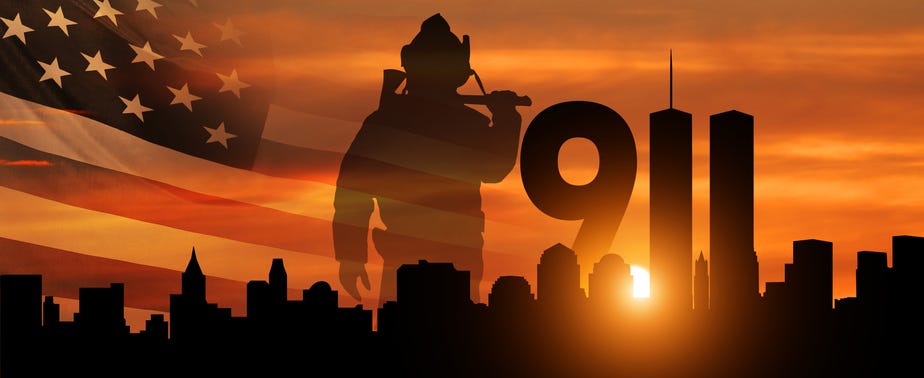
On September 11, 2001, the attacks on the United States were not just images on a television screen. Attacks were being launched against places that were deeply personal to me: the World Trade Center in New York and the Pentagon in Washington. My connection to the events of 9/11 eventually merged with my professional life when I joined the 9/11 Commission to examine the attacks and our nation’s response.
Experiencing 9/11 from these two perspectives, as an American who had spent significant time in both places attacked, and as a member of the 9/11 Commission tasked with telling the American people what happened, has informed how I think about not only the tragedy, but also the outpouring of global unity that occurred immediately afterward, and how we let that opportunity pass.
Personal Ties to Ground Zero and the Pentagon: Memories That Can’t Be Forgotten
I grew up in New York, and after graduating college and before going to law school, I worked as an intern and then an investigator near the World Trade Center at the New York City Corporation Counsel, the city’s law office. I walked those streets weekly in Lower Manhattan, passing the towers, visiting offices inside, even interviewing for a job there. My mother also worked in that area; we would stop by nearby shops on the way home from work.
Those memories are vivid: The physical presence of the towers themselves, amazing buildings, icons of the city skyline; the hum of daily life in the surrounding neighborhoods, including places where, during lunch, I would go to watch music videos; walking past the courthouse where a good friend of mine worked, a reminder of how modern and alive that part of the city felt.
I went back to that area after the attacks. Weeks later, it still felt surreal walking through downtown. An air of disbelief and shock hung over Lower Manhattan. We were all still in a daze. I was apprehensive about going there, so soon after what happened, but I felt I needed to see and feel that part of New York that was the victim of the terrorist attack, as we were all victims. Photos of the rubble and sacrifices lined the streets of Little Italy. I bought some of those images, and they still sit in my attic as artifacts of a moment when it was hard to fully accept what had happened.
We were so impressed by the bravery of the New York Firefighters, the first responders, the New York Police, and even the dogs helping find people buried in the rubble. I will always remember the photo in a New York newspaper of a man and his dog sleeping, exhausted from searching. Firefighters from other states and from Canada poured in to help. I knew that, from then on, my memories of that neighborhood before 9/11 would have to stand in for a reality that no longer existed. The physical landscape changed; what would not change was the emotional imprint of that place and time. I still miss the old New York skyline. When I see it in older television shows and movies, I still cannot fathom that those two amazing buildings are gone.
It didn’t stop there, though. After graduate school, I worked at the Pentagon as a Presidential Management Intern. I was also a Naval Reserve Officer and worked shifts at the Pentagon on a watch desk. Sometimes these shifts were long ones, 10–12 hours on reserve weekends and when I was on two-week reserve duty. I learned later that the part of the Pentagon where I worked had been recently renovated. It was also where the plane hit.
I didn’t get too far from that wound, either. For months I drove past the Pentagon on my way to work, forced to look at the gaping hole on the side of the building. It became a physical reminder that I saw every day.
In the immediate aftermath of 9/11, something else stands out in my memory: the remarkable sense of unity and patriotism at home.
I remember flags proudly displayed on almost every car antenna across the country. There was profound sorrow at the loss of life and at the destruction of a remarkable landmark like the World Trade Center. But there was also a sense of collective identity and purpose. For a moment, it felt as if the country knew exactly who it was and what it stood for.
A Rare Moment of Global Solidarity
Another striking aspect of that period was the extraordinary international response. For a brief moment, the world stood with the United States in a way that cut across traditional alliances and rivalries.
Perhaps the most symbolic sign of solidarity was that all NATO members invoked Article 5 of the NATO Charter, the obligation that an attack on one member is an attack on all. It was the first time Article 5 had been invoked (and the last time). It was a clear statement that the attack on the United States was seen as an attack on the shared security of the alliance. This was not a routine gesture. It represented a historic affirmation of collective defense and mutual commitment.
Support came from many directions: Canada, which noted earlier sent firefighters to New York, opened its airports to diverted flights, managing the sudden influx of stranded passengers with remarkable grace. Close allies such as the United Kingdom, Australia, Germany, France, and Japan expressed strong solidarity and offered military, logistical, and intelligence assistance. Russia and China publicly condemned the attacks. Iran’s President Khatami condemned the attacks, and the Iranian people held candlelit vigils for the victims. Later, Iran also cooperated with the U.S. on Afghanistan, working with the US on the Bonn Agreement and pledging to close its borders to prevent Taliban and al-Qaeda members from escaping. They agreed to assist if U.S. aircraft went down in Iran and arranged camps for Afghan civilians fleeing the Taliban.
It is hard to overstate how rare this moment was. Many of these countries did not share all of America’s interests, values, or policies. Yet in the days and weeks after 9/11, there was a deep sense that humanity itself had been attacked, that this was not just an American tragedy, but a global one.
Lost Opportunities
Unfortunately, cooperation with Iran switched when President Bush included Iran with North Korea and Iraq in his “Axis of Evil” speech in January 2002. And as the United States moved from immediate response into prolonged wars in Afghanistan and later Iraq, the global consensus began to erode. Many nations that had stood shoulder to shoulder with the U.S. soon questioned or opposed aspects of American policy. The 2003 war in Iraq divided many of our closest partners and raised questions about U.S. motives, intelligence, and strategy. The narrative of shared grief and collective defense gave way to debates over legitimacy, unilateralism, and long-term occupation.
9/11 as a Moral Mirror: Who We Are, and Who We Refused to Be
For me, 9/11 holds many memories not only of that day and the days following it as the country tried to right itself after a brutal attack to the gut. It is a remembrance of the days in New York before the attack that are forever gone, just like the towers themselves. It is also a test of who we are as Americans and as members of a global community. As we mark each new anniversary of 9/11, we are invited not only to mourn, but to reassess. Just as that day changed the United States, it also changed how the world saw us, and how we might have led the world toward a different future.
And while we cannot return to the atmosphere when sympathy and support for the United States were almost universal, and when NATO, allies in Asia, partners in the Middle East, and even historical rivals found common cause with us, we can remember that such moments are possible.
Bonnie D Jenkins is the Shapiro Visiting Professor at the Elliott School of International Affairs, George Washington University. She is also a Practitioner Senior Fellow at the Miller Center at the University of Virginia. She is the former Under Secretary of State from 2021 - 2024. She is also the Executive Director of Women of Color Advancing Peace and Security (WCAPS), an organization she founded in 2017. From 2009 – 2017, Jenkins served as Special Envoy and Coordinator for Threat Reduction with the rank of Ambassador. She is a retired Naval Reserve Officer and served as Counsel on the 9/11 Commission.