
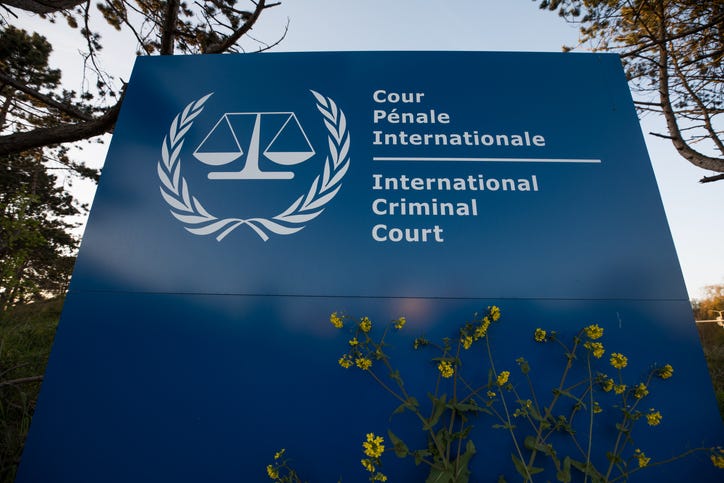
Recently, the United States administration has said it would like to dismantle the International Criminal Court (ICC). The ICC was established under the Rome Statute, which entered into force in July 2002. Under Article 51, the court has jurisdiction over the most “serious crimes of concern to the international community as a whole.” Those crimes consist of: (a) The crime of genocide; (b) Crimes against humanity; (c) War crimes; (d) The crime of aggression.
However, there is something the United States cannot do. As a matter of treaty law, the United States is not a member to the ICC. The United States did not ratify the Rome Statute. Therefore, the United States, unlike the 125 other countries that have ratified the Statute, has no direct authority to dismantle it. The Rome Statute also has no provision for “dismantlement” of the court. It has provisions for amendments, withdrawal of States Parties to the Treaty, and review of the statute’s provisions. And even if it did have such a provision, the U.S. could not avail itself of that provision since the U.S. is not a party to the Statute.
What the United States can do is exercise diplomatic, financial, and political pressure on States Parties to the Rome Statute in ways that may benefit or harm the ICC. The United States can sanction, or blacklist officials; pressure allies and like-minded governments; and refuse to comply with any lawful request the Court might make of the United States. However, the extent to which these U.S. actions have any effect is questionable. Such actions can instead alienate countries and may do lasting damage to other American interests at a time when the U.S. cannot afford to anger more countries, including traditional allies and partners.
The reality is that Washington no longer wields the coercive power it once did. The American administration may at this moment be taking its eroding global influence for granted. Global opinion of American policy, from our military interventions to our humanitarian responses, now affects Washington’s ability to compel diplomatic action on a mass scale. We have already witnessed the unwillingness of countries to provide assistance requested by the U.S. regarding Iran. When the United States tells allies, partners, and multilateral institutions that the ICC is illegitimate or harmful, we need to ask: who will do what we ask of them, and will they instead give the U.S. the side-eye in light of the U.S.’ own behavior?
Power relies on credibility, and credibility is hard to maintain when you do not practice what you preach. We expect our partners and allies around the world to meet certain standards. But international opinion is unlikely to take us seriously when we use sanctioned coercion against institutions that work toward the same goals we claim to espouse. Nor will they listen when we assault multilateralism and imperiously threaten institutions to which we are not parties but whose goal is to seek justice.
The ICC does not have jurisdiction to prosecute states. But the ICC can reach U.S. nationals. The Court can reach the nationals of non-state parties when crimes are committed on the territory of a State Party, when a situation is referred to the ICC by the UN Security Council, or when a non-State Party accepts ICC jurisdiction by declaration. When a country enters a war, and that country engages in possible acts that are considered illegal or unjustified, it must understand the position it places itself. Trying to intimidate a multinational court into abandoning its investigations will neither prevent the Court from pursuing investigations into possible serious crimes nor, in this case, restore America’s moral high ground. If Washington attempts such intimidation anyway, it only demonstrates that the United States has lost sight of important efforts to seek a functioning international legal order.
Bonnie D. Jenkins is the former Under Secretary for Arms Control and International Security and a lawyer with a focus on international law. She is also the former Ambassador and Coordinator for Threat Reduction Programs at the Department of State. Jenkins is an expert on arms control and nonproliferation of weapons of mass destruction. She is currently the Shapiro Visiting Professor of International Affairs and the Elliott School of International Affairs and is a U.S. Naval Reserve veteran. She is currently pursuing her SJD in international law at the George Washington University Law School. Jenkins is also the Executive Director of Women of Color Advancing Peace and Security (WCAPS).
Hopefully the ICC will not be intimidated by US threats..