
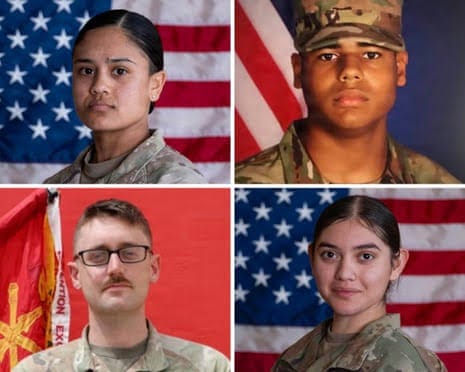
Photo from The Guardian
This past week, our country lost four more service members in the war in Iran. We lost soldiers who put on the uniform, raised their right hand, and volunteered to accept risks most Americans can never imagine. Among those we know we lost this past week are:
• 1st Lt. Tyler James Feehan
• Pvt. Isabella Gonzales
• Sgt. Angel S. Rampersad
• Sgt. Michael Emmanuel Swinton
These soldiers were more than numbers on a counter. They were daughters and sons, sisters and brothers, friends and teammates. They were people with whole futures ahead of them, futures they will never see because of what happened last week.
Unfortunately, the very basic truth of their sacrifice is being denied and minimized. The Pentagon’s official online casualty database dropped the listed number of U.S. service members killed in the conflict with Iran from 18 down to 14. The four Americans who lost their lives last week have been glossed over. That isn’t just an error. That is a form of erasure. Their bodies return home for burial with full honors, but their names are missing from the official roll of the fallen. When examined from a strategic view, this is part of a pattern.
The fallen Americans are two women and three people of color. We have seen how women and Black people have been denied promotions in the military. It is difficult not to make comparisons to other actions by the administration in the past months. To highlight a few, in the last year and a half, the Arlington National Cemetery unlinked and removed online educational guides, lesson plans, and “Notable Graves” landing pages dedicated to African American, Hispanic, and women’s history. The Pentagon flagged and ordered the removal of over 26,000 images and digital posts across military branch websites and social media channels commemorating minority milestones and heritage months. In addition, the American Battle Monuments Commission removed memorial panels detailing racial segregation and contributions of Black World War II soldiers at the Netherlands American Cemetery.
There has also been a fixation on changing the history at some of the Smithsonian Museums, the latest being the order by the White House for new signs outside the National Museum of American History that there may be “inaccurate” exhibits. It is all part of the pattern of pretending the history of America is not what it is…to deny or erase what is not liked.
When we send service members into harm’s way and expose their lives to danger on our behalf, the least we owe them is the truth. The truth about who they were; the truth that they were here, and the truth that they’re gone because they served their country.
To pretend otherwise, to erase them; to minimize their presence; to fail to speak their names as they should be, is a moral failing. It tells service members that some sacrifices are diminished in our memory; that some families’ grief is less painful, less legitimate.
Let’s be clear:
Not adequately recognizing those who gave to this country means we are standing by while the details of a loved one’s service and sacrifice are minimized, ignored, or erased.
When we do not fully acknowledge the service of some service members, we perpetuate a history in our country of demanding people’s labor, their courage, and their lives without fully accepting or respecting their contributions. That is not just unfair; that is antithetical to our values.
We cannot ask our military to wear our country’s uniform, to go wherever you send them, to face risks whenever you order them to, and then turn your back when they pay the ultimate price.
If we want to be a country that wants the service and sacrifice of Americans, we must be a country that will be honest about that sacrifice.
The very least we can do is to honor them and ensure their names are never erased from the records, reduced to a footnote in history, miscounted, or omitted from an official list of those who made the ultimate sacrifice.
We must do better.
And to the families of 1st Lt. Tyler James Feehan, Pvt. Isabella Gonzales, Sgt. Angel S. Rampersad, and Sgt. Michael Emmanuel Swinton:
We also see you. We acknowledge you, your family, and those you have lost.